
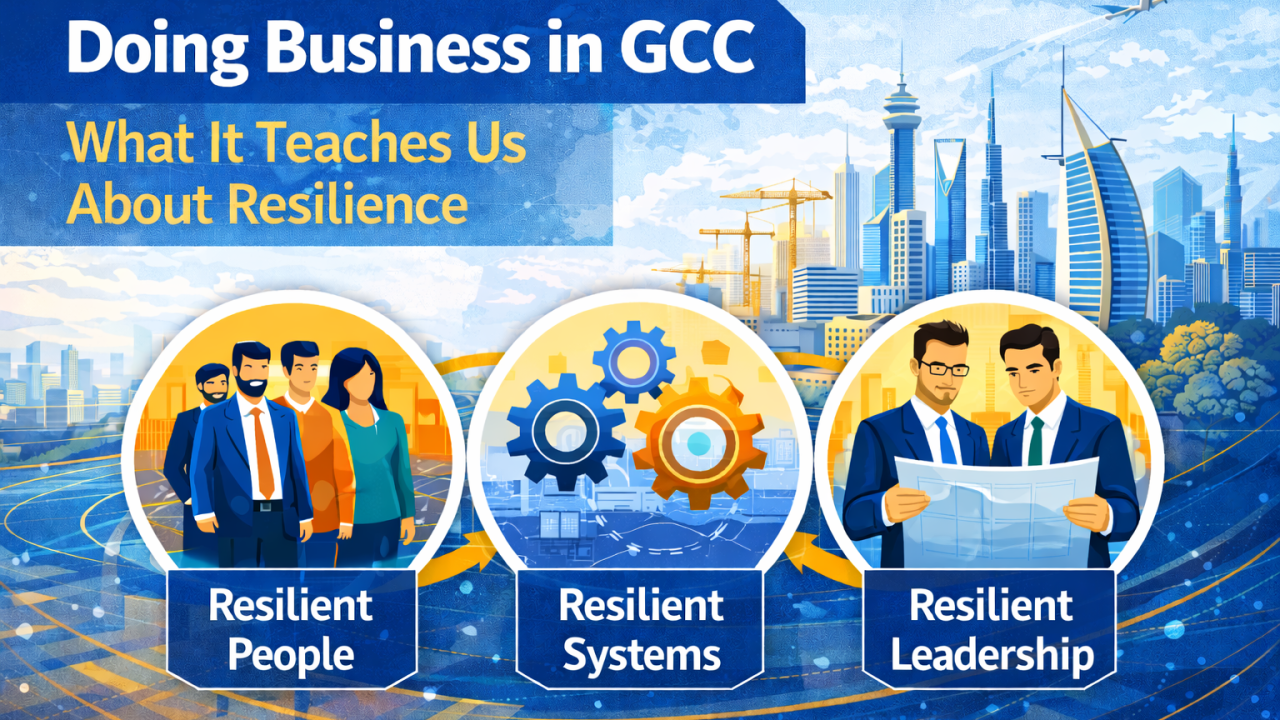
 This region has long positioned itself as a trusted springboard for global businesses. The salient character of this region is not just the ease of doing business but also its foolproof model in terms of business continuity and disaster, even in times of adversity. The GCC is not new to crises and has long established itself as a truly resilient business. Just a few years ago, when the world was constrained by COVID and life had come to a standstill, with businesses recalibrating their strategies, this region was the first to recalibrate, adjusting to the neo normal.
I remember standing on Sheikh Zayed Road on a late November evening in 2020. With the pandemic still at its peak worldwide, the city lights in Dubai were glowing as always. Construction cranes were still moving, and roads and airports were somewhat busy. The scene in the UAE was entirely different from the rest of the world. This is where businesses quickly adopted a robust business model by tailoring it to their specific business continuity needs. This transformation was supported by the strong government’s stewardship, backed by the people’s spirit of not giving in to adversity. Even in Saudi Arabia, similar sights were seen, where life did not take a recess.
That evening reminded me of something I later wrote in my book, Getting to Resilient Mode: “Resilience is not built in the middle of a crisis; it is cultivated long before the crisis arrives.”
What struck me was the region’s resilient mode. It was the quiet confidence of a place that refuses to pause.
For instance, during the recent developments in the US-Iran conflict, the UAE and Saudi Arabia, along with others in the region, were again confronted with challenges. However, the situation amidst these developments did not create panic in a general business sense, as the ecosystem in the region has a deep-rooted character to mitigate challenges and ensure business as usual.
As I live here and do business across the region, I can see the strong, resilient character of the region and its people. Having travelled in the region over the last few days, I could see that unwavering resolve.
Especially the KSA and UAE, the two regional economic majors, have indeed defied all the sceptics across their cities—be it Riyadh, Abu Dhabi or Dubai—serving as some of the most compelling living examples of this philosophy. It’s people, systems, and its leaders foretell this reality.
Over the years, as someone who has spent decades working in the built environment and facilities management sectors in the region, these examples stand out against the global scene. Beneath the skyline and the ambition lies something far more powerful: a carefully nurtured ecosystem of resilient people, resilient systems, and resilient leadership.
Resilient People
The region’s greatest strength is its people.
Millions of individuals from across the world arrive here with dreams, skills, and determination, hosted by amazing people of local descent—the nationals. This workforce diversity creates a remarkable culture of adaptability.
In my leadership articles over the years, I have often said: “Organizations do not become resilient through policies alone; they become resilient through people who refuse to surrender to adversity.” Living between Dubai and Riyadh, I see this spirit visible everywhere.
From frontliners to supervisors maintaining critical infrastructure, to entrepreneurs building new ventures, there exists a shared belief that tomorrow can always be built better than today. Resilience here is not merely spoken about. It is practised daily. We saw this during the 2008 financial crisis, the 2019 pandemic, and now in the recent developments.
Resilient Systems and Infrastructure
Equally important are the systems that support the region’s agility and preparedness to manage in times of need.
For instance, in the UAE, its uniqueness lies in the infrastructure designed not only for efficiency but also for endurance. Airports, logistics networks, utilities, digital governance platforms, and urban mobility systems operate with a level of integration that allows the city to absorb shocks without losing momentum. Even the supply chains maintain adequate supplies beyond essentials.
Over the years, these systems have learned about their vulnerabilities and consistently built infrastructure designed for business continuity.
“The true test of resilience is not how systems perform on ordinary days, but how reliably they function when uncertainty becomes the norm.” – a thought from my book truly reflects on today’s outcome. For those of us in the facilities management profession, this lesson is particularly powerful.
Buildings, cities, and infrastructure remain resilient not simply because they are well-designed, but because they are well-maintained, intelligently managed, and continuously improved.
A defining strength of both the UAE and Riyadh lies in how execution is embedded within the system itself. It is their resilient systems that these have built over the years that worked in times of need. In the UAE, governance operates through tightly integrated platforms where civil defence, aviation, municipalities, and security agencies move in coordination, supported by real-time information and clearly defined response protocols. Decisions are swift, communication is measured, and continuity is preserved without visible disruption.
In Riyadh, the same discipline is reflected through Vision 2030, where ministries, project authorities, and regulators function within structured frameworks with clear accountability and escalation paths. Whether through coordinated crisis committees or national platforms overseeing critical sectors, there is a consistency in how operations are sustained.
What stands out is that progress does not pause to recalibrate. The system continues to move, quietly and steadily, ensuring that essential services, markets, and infrastructure remain functional. It is this institutional strength built over time that allows both economies to maintain momentum, even when the external environment is uncertain.
Resilient Leadership
Perhaps the most important pillar of resilience is leadership—from the rulers to executive leadership—supported by robust private sector entrepreneurs.
Leadership in the region has consistently demonstrated a rare combination of long-term vision and decisive action in moments of crisis. Development here is not reactive, nor an afterthought, but perpetual and designed for purpose. Strategic clarity, policy stability, and encouragement of enterprise have created an environment where institutions and individuals can plan confidently for the future.
Resilient societies are rarely accidental. They are shaped by leadership that believes in possibility even during moments of uncertainty.
The Resilience Triad
When resilient people operate within resilient systems under resilient leadership, a powerful dynamic emerges.
Cities do not merely survive disruption. They evolve through it. Dubai, as a city, is one such example. It reminds us that resilience is not about resisting change. It is about building the confidence, capability, and culture to move forward despite change.
As I often conclude in my reflections on resilience: “Strong institutions are built when people, systems, and leadership move in the same direction.” I believe this region is a compelling example of that alignment today.
And perhaps that is why, regardless of global uncertainty and its media explosion , this region, especially KSA and the UAE, continues to move forward with remarkable conviction, navigating every moment of test with flying colours.