

Facilities Management (FM) is, at its core, a frontline business. Unlike asset-heavy industries, value in FM is created daily, often invisibly by technicians, cleaners, help-desk agents, supervisors, and site FMs who operate closest to the customer. In such people-centric environments, service excellence and profitability are not driven by manuals or technology alone; they are driven by human engagement.
Over the years, one truth has consistently proven itself: organizations that invest deeply in employee engagement, especially at the frontline-centric inevitably upend service delivery outcomes, client satisfaction, and financial performance.
Why Engagement Matters More in Facilities Management Than Anywhere Else
FM teams operate under three defining pressures:
- High visibility, frontline actions are immediately felt by clients and end users
- With continuing pressure, resulting in thin margins, small inefficiencies and employee disruption can quickly erode profitability
- Distributed operations with large number of employees across multiple sites, shifts, and geographies
In this environment, disengagement shows up fast: absenteeism, quality slippage, rework, client complaints, and attrition. Conversely, engagement multiplies productivity, stabilizes costs, and elevates client trust.
Sustainable engagement in FM is not built on one initiative. It is a system, anchored on six interlinked pillars:
Structured Employee Progression & Development
Frontline employees stay engaged when they can see a future. Clear skill ladders, internal mobility, supervisor readiness programs, and continuous learning create aspiration and ownership.
At EFS Facilities Services Group, frontline development has been treated as a strategic investment—not an HR cost. Structured technician upskilling, site-based leadership grooming, and internal promotions have consistently:
- Reduced voluntary attrition
- Improved first-time-right service delivery
- Created site leaders who understand both people and clients
The result is not just happier employees, but more accountable operations.
Compassion-Led Leadership & Welfare Initiatives
FM work is physically demanding and emotionally taxing. Compassion is not a soft concept here—it is an operational necessity. Welfare initiatives, health support, safe accommodation, fair rostering, and crisis support build trust at the grassroots level.
EFS’ experience demonstrates that when employees feel cared for beyond compliance:
- Attendance improves
- Safety incidents decline
- Productivity stabilizes even under pressure
Compassion creates loyalty and loyalty protects margins.
Robust Grievance Management & Voice Mechanisms
In large FM organizations, silence is dangerous. Unheard grievances often turn into disengagement, errors, and exits. A credible grievance management system; one that is accessible, fair, and fast, signals respect.
By strengthening grievance redressal channels and site-level listening mechanisms, EFS has repeatedly seen:
- Early resolution of operational friction
- Reduced conflict escalation
- Stronger supervisor credibility
When employees trust the system, they stay focused on service, not survival.
Daily Engagement, Not Annual Surveys
True engagement in FM happens daily, not just through annual surveys. Toolbox talks, site huddles, recognition moments, supervisor check-ins, and real-time feedback loops keep employees connected to purpose and standards.
EFS’ frontline engagement practices embedded into daily operations have helped convert routine tasks into ownership-driven outcomes, where employees act as custodians of client environments rather than task executors.
Strong learning and development Push
In a large frontline workforce learning and Development requires a dynamic push as service delivery qualitative outcomes requires continuous upskiiling besides this helps in boosting productivity that eventually results in profits upside.
Progression and Development
Beyond learning, the organization needs to build a minimum threshold to ensure the frontline workforce gets opportunities in the company progression. This helps build strong employee and customer retention. In FM, employee progression is a known enabler in boosting profits.
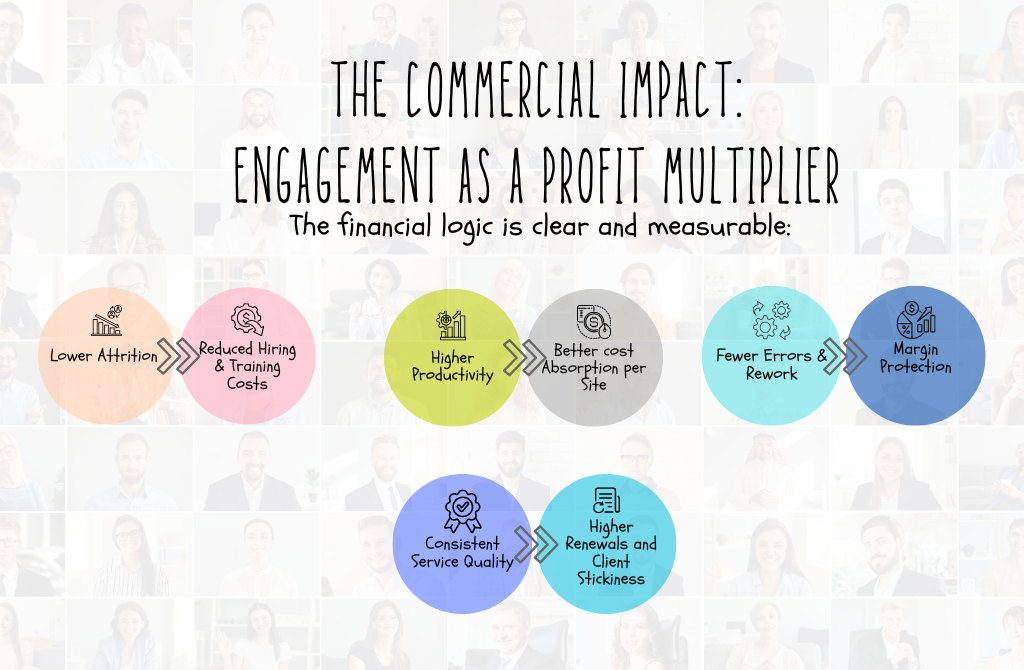
At scale, these effects compound. EFS’ proven track record shows that engaged frontline teams consistently outperform on service KPIs while sustaining margin resilience, even in competitive and price-sensitive markets.
Reframing Engagement: From Cost to Competitive Advantage
In FM, employee engagement is often discussed as a moral or cultural imperative. It is that but it is also a powerful commercial lever. Organizations that treat engagement as strategy not sentiment, create a differentiated operating model that competitors struggle to replicate.
In frontline-centric industries like Facilities Management, the shortest path to superior service and sustainable profits runs straight through the employee experience. Invest in progression, lead with compassion, listen with intent, and engage every day and the business outcomes will follow.
People first is not a slogan. In FM, it is a proven business model and a key business driver.