
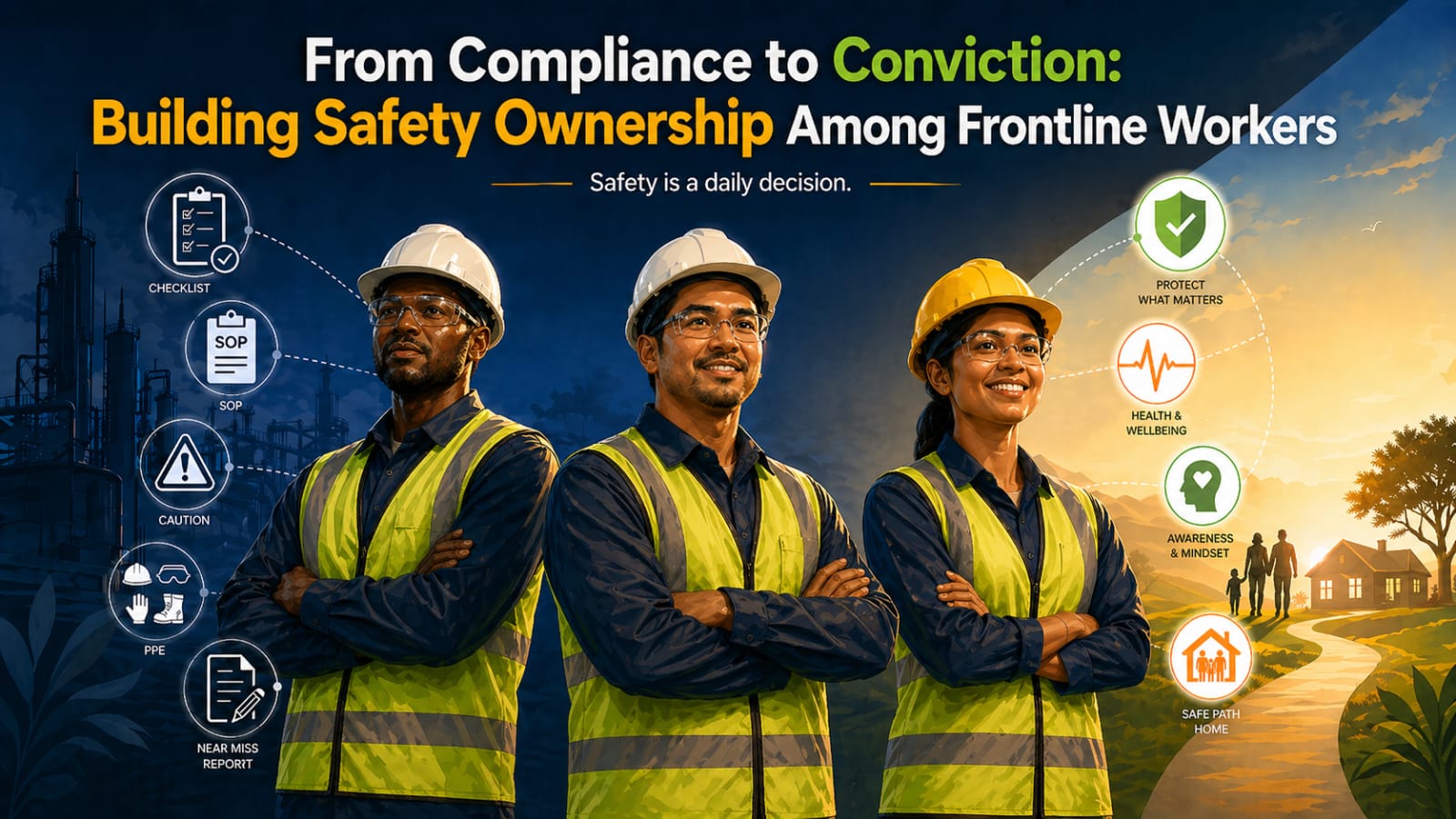
Frontline worker safety remains one of the most discussed, yet least internalized, realities of our industry. Over the years, I have seen safety framed through multiple lenses: clients guarding their reputation, companies enforcing contract governance, and regulators tightening compliance. All of this is necessary. Yet, it still misses the most critical lens: the worker’s own conviction to stay safe.
For the frontliner, safety is often reduced to a checklist – helmets, gloves, SOPs, toolbox talks. It is seen as workplace discipline, not life preservation. And that is where the gap begins.
Global data reinforces this uncomfortable truth. According to the International Labor Organization, nearly 2.9 million people die each year from work-related causes, with over 374 million non-fatal workplace injuries annually. Closer to our operating realities, studies consistently show that 80–90% of incidents are linked to unsafe behaviors rather than unsafe conditions. Even more concerning is the ratio of near misses, often cited as 1 serious accident for every 300 near misses. These are not just statistics; they are warnings ignored, signals unheeded, and opportunities lost.
In my experience of over two decades of frontline engagement, I have learned that safety failures rarely stem from a lack of infrastructure. PPE is available. Procedures are documented. Training is conducted. Yet incidents happen. Why?
Because ownership is missing.
The frontline worker does not wake up intending to be unsafe. But over time, familiarity breeds complacency. “Nothing happened yesterday” becomes “nothing will happen today.” Shortcuts become efficiency. Risk becomes routine. And slowly, safety shifts from being a personal shield to a perceived organizational burden.
This casual attitude is not mere ignorance; it is a deeper disconnect from understanding the multiplier impact of safety lapses.
How often I see that most minor injuries go unreported, what we refer to as near misses, yet they never truly come onto the radar as such. It is common for workers and supervisors to simply not report them. These seemingly minor injuries often evolve into recurring health concerns. Why are they ignored? There are multiple reasons: culturally, there is low sensitivity to minor incidents; there is an aversion to consistently using the right PPE; and there is a clear gap in supervisory oversight. At the initial occurrence, there is often a silent disregard. When I visit sites, I often see employees limping, carrying minor bruises, or walking around with stitches. What troubles me most is not just the incident itself, but the casual response to it from supervisors and managers.
A single incident is not just a momentary injury. It is:
- Loss of income and financial instability for families
- Reduced physical capability impacting long-term employability
- Mental health strain from trauma, fear, or dependency
- Social consequences that extend far beyond the workplace
For a frontline worker, an injury is not a statistic; it is life-altering. And yet, we continue to communicate safety as rules rather than as consequences.
This is where leadership – true, grounded, people-first leadership – must intervene. Not through more policies, but through changing the narrative.
We must move from:
- Compliance to Conviction
- Rules to Responsibility
- Monitoring to Mindset
Safety must be reframed as self-preservation, not supervision.
From my own journey, the most effective safety cultures I have seen were not the ones with the strictest enforcement, but the ones where workers believed: “I wear PPE not because I am told to, but because I want to go home safe.” This belief does not come from posters or penalties. It comes from: continuous engagement, not one-time training; storytelling of real incidents, not theoretical risks; connecting safety to family, livelihood, and dignity; and building supervisors as safety leaders, not task enforcers.
Supervisors, in particular, are the most underleveraged force in safety transformation. When a supervisor evolves from a “work allocator” to a “risk manager,” safety becomes embedded in execution, rather than appended to it.
Equally important is how we treat near misses. In many organizations, near misses are either underreported or ignored. This is a strategic mistake. A near miss is not a non-event; it is a free lesson. Organizations that build a culture of openly reporting and learning from near misses create a predictive safety environment rather than a reactive one.
Technology can support this journey with AI-driven risk analytics, real-time reporting tools, and predictive maintenance, but technology alone cannot solve a behavioral gap. The real shift must happen in the human mind.
Safety, at its core, is deeply personal. It is about a worker choosing to pause before taking a shortcut. It is about speaking up despite pressure. It is about recognizing that one moment of negligence can undo years of hard work. As industry leaders, we must ask ourselves a difficult question: Are we building compliant workforces or conscious workforces? Because compliance can be enforced. But consciousness must be inspired.
In the end, safety is not a department. It is not a KPI. It is not a contractual clause. It is a daily decision, taken by every frontline worker, every minute. And until that decision becomes instinctive, our frameworks will remain strong on paper, but fragile in practice.