
 In our pursuit of life, encompassing lifestyle, family, and career, we tend to overlook certain vital essentials, such as health and well-being. These elements are must-dos or, I would say, integral to these pursuits, complementing your desired life goals. Therefore, it should be known that ignoring health and personal well-being is bound to contravene your larger goals.
When it comes to your well-being, it encompasses both physical and mental health. This is another paradigm of self-actualization that only some people understand. In this narrative of good health, besides its benefits of comfort and ease in life, there is another important factor, which is financial assurance. One must know that poor health and its associated costs are bound to impact your plan; as I would say “Man plans, but bad health can dispose it all.” Effectively managing health and well-being costs and reaping the benefits is what I refer to as health economics.
When health vitals decline, we rush to seek medical help, which involves both time and cost; the net impact is hardship and expenses. Either way, it has financial implications, as even with insurance, there is an indirect cost burden. There are costs in terms of depleting leave balance at work for employees and the logistical expenses associated with travelling to and fro for doctor visits. Though this may seem minuscule, all of this adds to your bills. People often overlook these hidden costs. In conclusion, any health care concerns take its toll on your productivity and your family too bears its brunt, adding to their woes.
My objective in this opinion piece is to raise awareness that health and well-being costs have direct and indirect dimensions that people often do not relate to. A good well-being goal is wholly dependent on many factors, from your lifestyle discipline and balanced diet to fitness regime and better disease management, if any. Any deviation from these factors can negatively impact your well-being and, of course, its associated costs. However, are we aware of how these financial impacts play out and the importance of understanding them?
According to World Health Organization (WHO) analytics, poor health at the individual level is over 10% of the average household income and more so in white-collar segments. Besides taking into account the lost opportunities from career prospects, it has far-reaching effects on family relationships and mental health. The WHO monitors the financial burden of health care on households through indicators like the proportion of the population incurring high health care expenses. This is defined as households’ spending more than a certain percentage of their total outlays or income on health care, with household health expenditures exceeding a significant portion of their total household income.
There is a much higher impact of this paradigm globally with high out-of-pocket healthcare expenses and financial hardship pushing employees into debt and mental health issues. Therefore, I would like to explain how poor health can significantly affect the working population and employees’ financial stability.
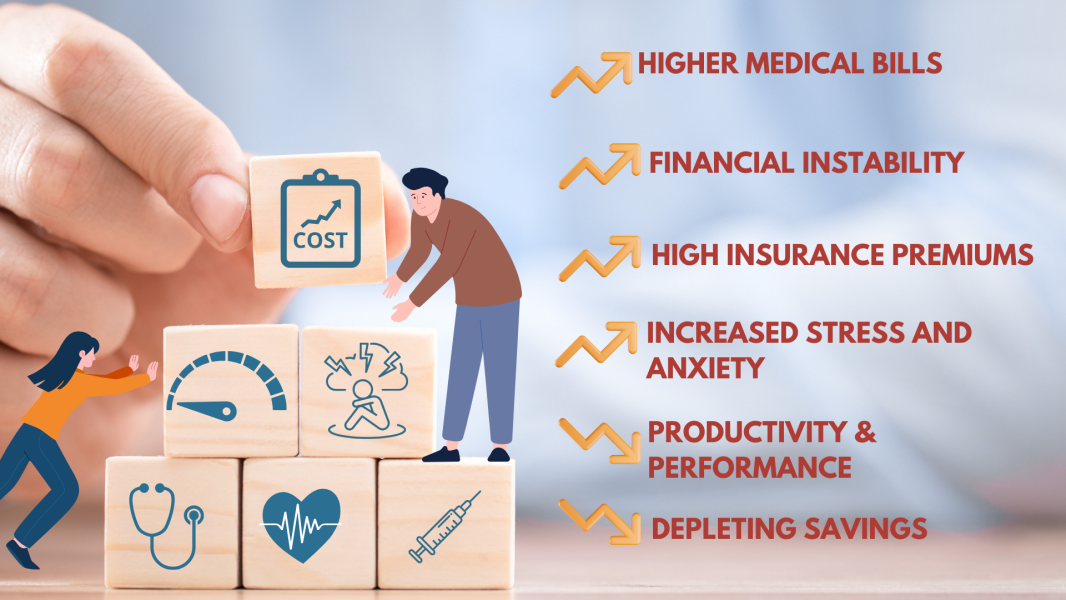
- Increased health issues often lead to higher medical bills for doctor visits, medications, treatments, and other related costs, thus straining personal finances.
- Lost income impact: Employees with chronic health and missing workdays are bound to impact wage bills, leading to deductions such as loss on pay leaves, reducing their income and exacerbating financial instability.
- Poor health can decrease productivity and performance, resulting in fewer promotions, raises, or bonuses.
- Job losses and insecurity: Long-term health problems can lead to job loss or the inability to perform specific tasks, making it challenging to find new employment, particularly in physically demanding jobs, which adds to stress.
- High insurance premiums: Individuals with pre-existing health conditions are likely to face higher insurance premiums or certain deductions, which adds to the financial burden.
- Financial strain can lead to increased stress and anxiety, which can further impact mental and physical health, potentially creating a cycle of worsening health and economic instability.
- Employees in the advanced age group often resort to drawing from their retirement savings leading to depleting critical savings. Chronic health problems may force employees to withdraw from retirement savings or delay contributions, affecting long-term financial security. Financial strain can impact the entire family. An employee’s poor health may necessitate that family members may need to take time off work to provide care, reducing their income.
Overall, the interplay between poor health and financial stability is about the prudent management of your health well-being economics. If this is not managed well, it can create a challenging situation, affecting their quality of life and economic security. The concept of self-management is very important and is perhaps the solution for managing ill-health. It refers to the self-awareness and independent ability to pursue individual priorities, from hobbies to other interests. Finding “me time” is essential for personal space that elevates self-actualization, ultimately enhancing our performance in all different life pursuits.