
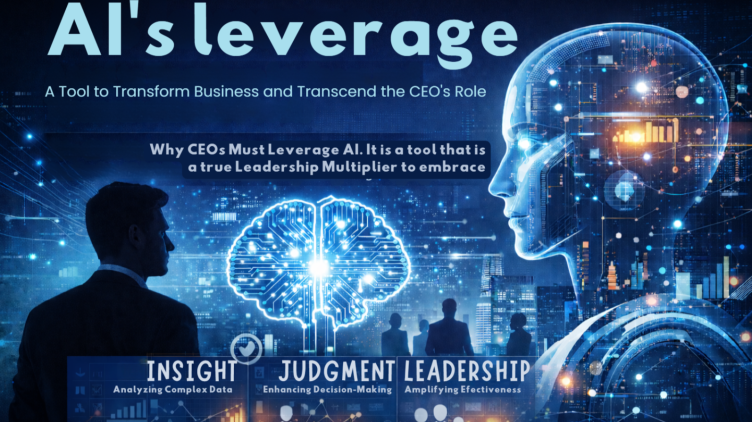
Why CEOs Must Leverage AI. It is a tool that is a true Leadership Multiplier to embrace, transforming insight and judgment.
AI, the buzzword, has become an integral part of our lives, impacting everyday life. People often describe artificial intelligence as a tool for boosting productivity, speeding up information processing, or making routine tasks easier. In my view, this only presents a microscopic perspective, as AI leverage is revolutionary. For leaders in complex, people-focused industries, AI is more than a convenience. It is changing how decisions are made, how risks are managed, and how organisations operate.
AI is not meant to replace human judgment, but to improve it. When used well, AI helps leaders spot patterns across locations, identify new risks, and notice issues they might otherwise miss. People still make the decisions, but AI gives them better information to work with. This change affects how work is organised.
With AI, Leaders move from models based on manual reporting and control to deep foresight that helps them focus beyond analytics. These help leaders, managers, and supervisors lead rather than just react. Including in their engagement with their frontline teams, as these get more clarity on leadership directions, ultimately helping boost productivity, not just working harder.
Many people in organisations still see AI as just a technical project, limited to small trials or specialist teams. This approach holds back its potential. AI makes a real difference when it is part of daily leadership routines. It helps with reviews, planning, and the FM industry, specifically in asset management, energy use, and overall contract management strategy. In most areas, AI does not provide all the answers, but it helps leaders ask smarter, more informed questions.
Culture is still key. AI does not work well when used solely for automation. It works when leaders show that insight is more important than just being busy, and that technology should help, not replace, human judgment. Using AI ethically, being transparent, and putting people first are not limits; they are what make AI trustworthy.
In fields like facilities management, where operations cover many sites, assets, and workers, there is little room for mistakes. Even small inefficiencies can add up fast. Bad decisions can impact safety, costs, service quality, and trust. Data has always been important in these settings, but now we can connect, understand, and use it much faster and more effectively. Facilities management shows this shift well. The sector used to rely on fixed plans and set agreements but is now moving toward more flexible performance management. AI enables predictive maintenance, adjusts energy use, and creates service models that respond to real-world situations. These changes not only improve profits but also make operations safer and more reliable.
I think very few Leaders in today’s context would question the use of AI, but the real issue is whether they will use it simply to do old things faster, or to rethink how their organisations lead, set priorities, and deliver value on a large scale.
I, too, have personally transformed my enterprise management with AI, using insights to analyze complex data into clear, decision-ready intelligence. With foresight to anticipate risks, trends, and opportunities, and, lastly, the leverage that amplifies my judgment, speed, and perspective, as I am really elated with the organizational impact through AI-powered decision-making, including torpedoing my own personal productivity.
Those who treat AI as a marginal efficiency tool will see incremental gains. Those who treat it as a leadership discipline will redefine performance. In industries built on complexity and human engagement, the difference will determine who remains competitive, resilient, and trusted in the years ahead. To conclude, as leaders, the choice is ours.